US Deploys 9,000 Troops and Third Carrier to Gulf
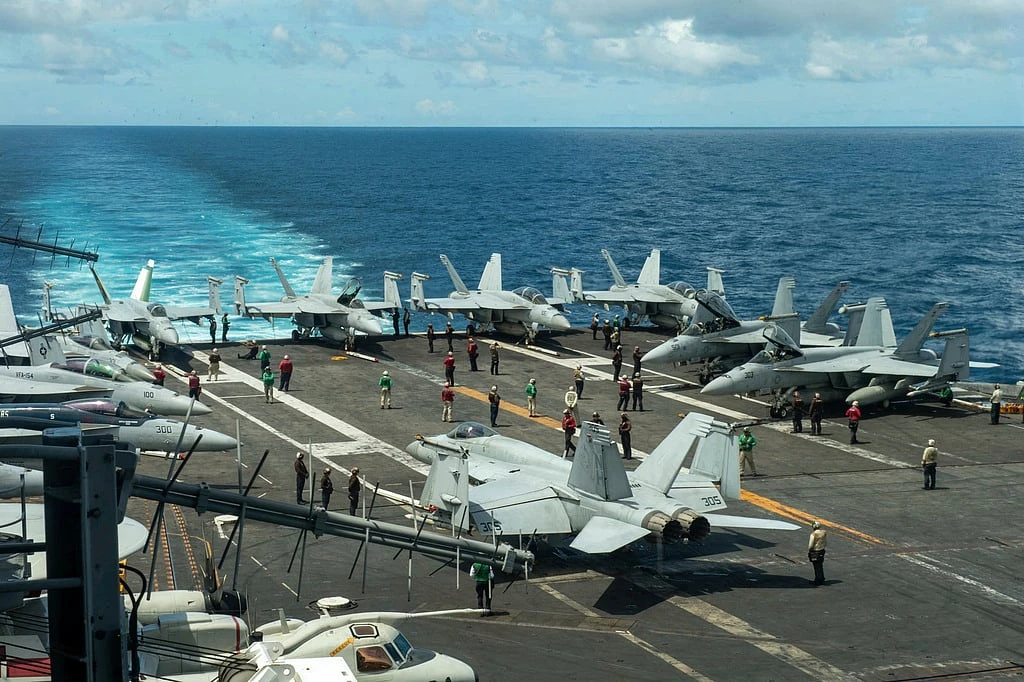
The United States is significantly reinforcing its military presence in the Middle East, deploying approximately 9,000 troops and moving toward a three-carrier presence in the region. This massive deployment comes as regional instability reaches a boiling point following a series of targeted attacks on maritime vessels and land-based infrastructure.
Maritime Targets Under Fire
The security situation in vital shipping lanes has deteriorated rapidly. In the Strait of Hormuz, the Kazimah III, a Very Large Crude Carrier (VLCC) operated by the Kuwait Oil Tanker Company, was struck by an unidentified projectile. While the UK Maritime Trade Operations (UKMTO) confirmed that a fire broke out on the vessel, the crew was reported safe.
The violence has also extended to land-based maritime hubs. On October 1, an unidentified projectile hit a terminal at the Saudi Arabian port of Yanbu, temporarily halting operations for a Liberian-flagged tanker. This incident follows a week of heightened maritime aggression, with reports of attacks on several other vessels, including the ADNOC Logistics tanker Al Ruwais and the VLCC Mersin Prosperity.
Escalating Missile and Drone Attacks
On the ground, Saudi Arabian air defenses have been working overtime to counter Houthi threats. On October 1, coalition forces successfully intercepted two ballistic missiles and four drones aimed at Khamis Mushait and Jazan. While the interceptions prevented mass casualties, debris from a missile strike in Khamis Mushait caused damage to residential buildings and vehicles.
Further instability was reported in the Houthi-controlled capital of Sanaa, where loud explosions and smoke plumes were observed. Houthi media attributed these blasts to airstrikes conducted by the Saudi-led coalition. Meanwhile, a subsequent Houthi missile targeting Khamis Mushait was intercepted on the morning of October 2.
US Naval Surge and Military Reinforcement
In a direct response to the escalating conflict, the United States is rapidly expanding its regional footprint. According to reports, the USS Theodore Roosevelt carrier strike group and the USS Makin Island amphibious readiness group are currently en route to join the USS George H.W. Bush and USS George Washington.
The reinforcement package includes:
- The cruiser USS Chosin
- Landing ships USS John P. Murtha and USS Anchorage
- Approximately 2,000 marines from the 13th Marine Expeditionary Unit
US officials expect to have three aircraft carriers operational in the region by late October or early November.
Economic and Political Fallout
The geopolitical tension is driving significant economic shifts. Brent crude oil prices have surged past $102 per barrel as markets react to the instability. Additionally, tanker-tracking data suggests that Iranian exports have largely stalled since mid-August, forcing a greater regional reliance on pipelines leading to the Red Sea.
Politically, the situation remains deadlocked. President Trump recently rejected an Iranian ceasefire proposal, describing it as "not good enough" and suggesting that larger military strikes remain a possibility. In tandem with military movements, the US Treasury has imposed fresh sanctions on Iran’s automotive and rail sectors, while the Pentagon has awarded a $24.4 billion contract to Raytheon to accelerate the production of Standard Missile-6 units.
Aviation Disruptions Across the UAE
The conflict is also heavily impacting regional travel. Major aviation hubs, including Dubai, Abu Dhabi, and Sharjah airports, have seen numerous flight cancellations and diversions.
In a notable incident on September 30, a flydubai flight (FZ1073) traveling from Dubai to Tel Aviv was forced to make an emergency landing in Tabuk, Saudi Arabia, after both pilots were injured during a cockpit incident. The UAE Attorney General is currently investigating whether the incident involved terrorism or external direction, with links being suggested to the IRGC.
While some carriers like Philippine Airlines have resumed service, several major international airlines—including Air Canada, Cathay Pacific, Singapore Airlines, Air France, and KLM—have extended their flight suspensions into late October or even into 2027.