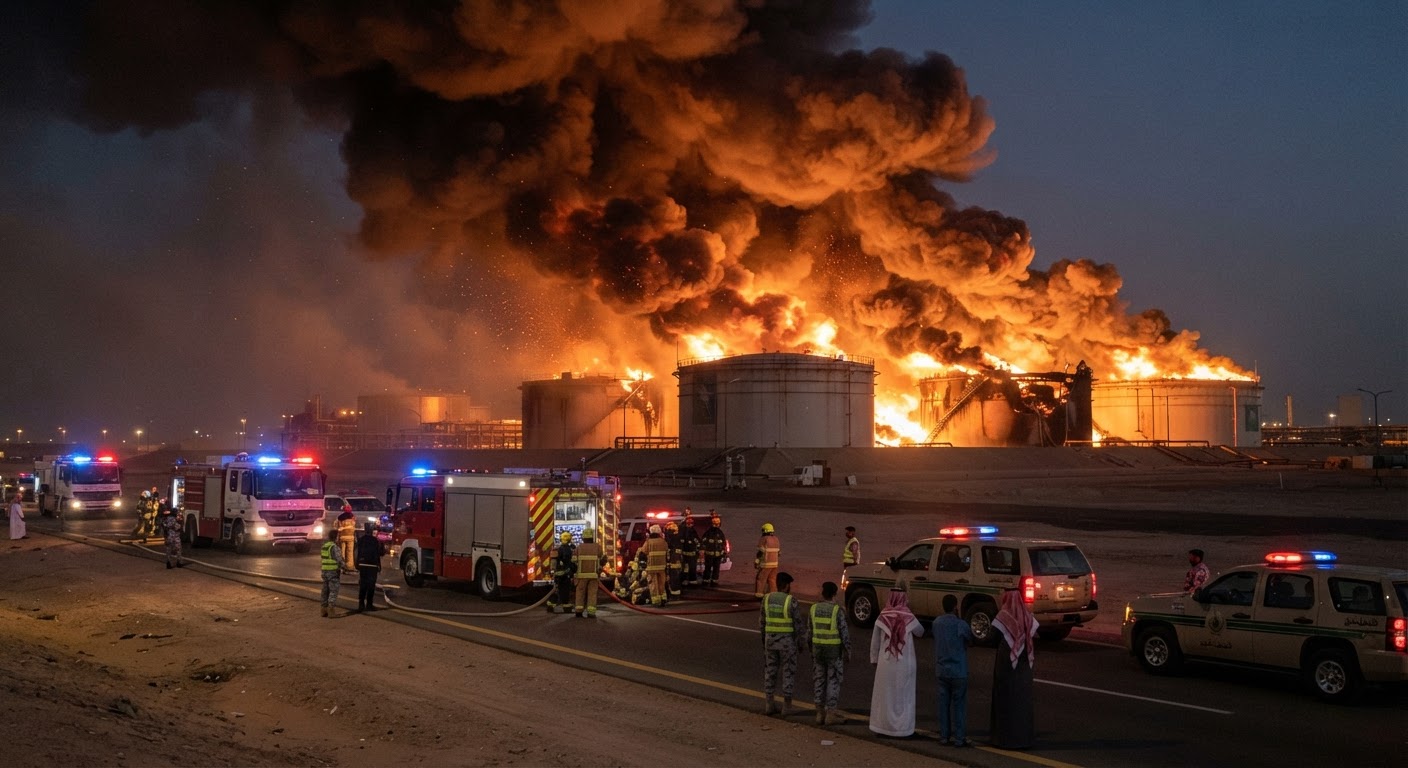
Explosions were heard across Riyadh overnight into Saturday, marking the first time the Saudi capital has been placed under an air-raid alert since the most recent escalation of the conflict on the Yemen front began this month. Saudi Civil Defence issued an alert to mobile phones across the kingdom warning of a hostile aerial threat, instructing residents in Riyadh and Al-Kharj to remain indoors. Following the blasts, a large fire erupted at an Aramco fuel storage tank located near King Khalid International Airport, sending a column of black smoke over the facility. FlightRadar24 reported severe disruptions to air travel, with numerous delays and cancellations.
Explosions were heard across Riyadh overnight into Saturday, marking the first time the Saudi capital has been placed under an air-raid alert since the most recent escalation of the conflict on the Yemen front began this month.
Saudi Civil Defence issued an alert to mobile phones across the kingdom warning of a hostile aerial threat, instructing residents in Riyadh and Al-Kharj to remain indoors. Following the blasts,
a large fire erupted at an Aramco fuel storage tank located near King Khalid International Airport, sending a column of black smoke over the facility.
FlightRadar24 reported severe disruptions to air travel, with numerous delays and cancellations. The incident follows weeks of exchange between Iran-backed Houthi forces and Saudi-backed units in Yemen. Houthi forces claim Saudi jets conducted 26 strikes in 24 hours and over 300 in the past week. While Saudi authorities are investigating the cause of the Riyadh explosions and the fire at the Aramco site, officials have not yet officially identified the weapon or the party responsible. An AFP journalist observed crews working on a damaged tank bearing the Aramco logo, while Reuters documented the smoke plume near the airport highway and terminal.
Authorities have prohibited the public from gathering or filming near the site.
The United Nations Security Council has condemned Houthi attacks on Saudi civilian and energy infrastructure, calling for an end to the escalation. Simultaneous fighting in Yemen has displaced tens of thousands, with clashes reported over high ground overlooking the Bab al-Mandab strait. The regional instability stems from a broader six-month conflict initiated in February following U.S. and Israeli strikes on Iran, leading Tehran to target GCC capitals hosting American military assets. Diplomacy in Oman regarding shipping through the Strait of Hormuz has been postponed following stalled Saudi-Iran talks.
Transportation impacts extended across the Gulf, as Flydubai cancelled services to Bahrain, Abha, and Yanbu. Flight routes through Abu Dhabi and Sharjah to Kuwait and Bahrain have also faced cancellations. Additionally, Iran announced the execution of an individual convicted of passing military information regarding sites in Isfahan to Israel. Tehran also claimed to have struck a Togo-flagged tanker in the Strait of Hormuz for unauthorized transit, while a separate unidentified vessel was struck by a projectile near the strait.
India has urged the UN Security Council to protect commercial shipping from being used as a bargaining chip in the ongoing conflict.