A Missile Landed in UAE Waters This Week. Here Is What Has Hit Every Gulf Country Since This War Began.
Two days ago, a ballistic missile fired from Iran landed inside UAE territorial waters. The country you live in was struck — not a headline from somewhere else, not a story about a neighbour, but this water, this coastline. It caused no damage and no injuries, and it barely disrupted your week. But it happened, and it is worth understanding exactly what it means, alongside what has hit every other Gulf state around you, because the picture across the five countries is not the same story repeated five times. It is five very different exposures to the same war.
Here is where things actually stand, country by country, as of 21 August 2026.

UAE — a missile in your own waters, and a trade freeze with Iran
What happened this week. On 19 August, the UAE Ministry of Defence confirmed it had detected two ballistic missiles launched from Iran, both targeting maritime navigation in the Strait of Hormuz. The first fell outside UAE territorial waters. The second fell inside them. Neither caused damage on land. The Ministry stated the country "remains on high alert and fully prepared to respond to any threats," and confirmed its air defence systems had intercepted multiple threats during the same period.
The direct consequence: the UAE has suspended all trade and financial transactions with Iran until further notice — commercial exchanges, bank transfers, remittances involving Iranian entities, and maritime trade and logistics operations, all halted. If you have business dealings with Iran, family financial ties, or pending payments connected to Iranian entities, this freeze applies to you and there is no announced end date.
What happened earlier this year. This was not the UAE's first direct hit. On 1 March 2026, Iranian drones and missiles struck across the country in what the Ministry of Defence called "a blatant act of aggression." Three people were killed — a Pakistani, a Nepalese and a Bangladeshi national — and 58 were injured. Drone debris damaged the Etihad Towers complex in Abu Dhabi, injuring a woman and her child. Two drones targeted a warehouse at Al-Salam naval base. Shrapnel injured two people in Dubai when drones were intercepted over residential areas, and the Burj Al Arab, Palm Jumeirah and Dubai's international airport all sustained damage. A berth at Jebel Ali port caught fire from intercepted missile debris. In total, UAE defences detected 165 ballistic missiles (152 destroyed), 2 cruise missiles, and 541 drones (506 destroyed) that day.
Where things stand now. No further attacks have reached UAE territory since March, until this week's missile in territorial waters — which caused no casualties. Airports, ports and daily life continue operating normally. The trade freeze with Iran is the concrete, ongoing change to be aware of.
Saudi Arabia — the Houthi front reopens
What happened this week. On 20 August, Yemen's Houthi movement claimed two drone strikes inside Saudi Arabia's southern Najran region, near the Yemeni border — one targeting Najran Airport, the other an Aramco facility in the same area. Houthi military spokesman Yahya Saree said the group had "successfully carried out two military operations using drones." Saudi Arabia had not confirmed or commented on the strikes at time of writing, and no casualties were reported.
The wider pattern. This is part of a front distinct from the direct Iran-UAE-Gulf exchanges: the Iran-aligned Houthis resumed hostilities against Saudi Arabia after welcoming an Iranian aircraft into Sanaa, triggering a new round of attacks on Saudi ships, airports and oil facilities, including a maritime blockade the Houthis declared against the kingdom. Aramco's Ras Tanura refinery was shut down earlier this year following a separate drone attack. Saudi Arabia has responded with its own strikes on Iran-backed militia positions in Iraq following drone attacks on its oil infrastructure. Iran's Revolutionary Guards have separately warned that Saudi Arabia would be "unable to contain" the Houthis as attacks intensify.
Why it matters beyond Saudi Arabia. Aramco is one of the world's most important oil producers. Every strike that reaches its refining or export infrastructure is a factor in the oil price that has been climbing past $115 a barrel this month — the same price surge behind the rupee's record fall against the dirham, and behind pressure on import-dependent economies across the region.
Qatar — home to the largest US base in the Middle East, and already hit once
What happened. Qatar hosts Al Udeid Air Base, the largest American military hub in the Middle East. Some US personnel were advised to leave the base as early as January 2026 — described at the time as "a posture change, not an ordered evacuation" — as tensions built. The precaution proved warranted.
In late February, Iran launched a large-scale attack directly on Qatari territory: 65 ballistic missiles and 12 drones. Qatar's defences intercepted 63 of the missiles and 11 of the drones — but two missiles reached Al Udeid Air Base itself, injuring eight people, ranging from critical to moderate, alongside material damage to the base. No fatalities were recorded. Days later, in early March, two Iranian Su-24 bombers were reportedly intercepted by Qatari fighter jets just two minutes from reaching the base.
Where things stand now. Al Udeid remains operational, with US and Qatari forces maintaining heightened readiness. It is, alongside Kuwait and Bahrain, cited by regional aviation trackers as carrying some of the "greatest near-term risk" for further flight disruption in the current phase of the conflict.
Kuwait — the deadliest single strike on a Gulf civilian target
What happened. In the early hours of 3 June 2026, Iran launched a coordinated barrage of ballistic missiles and drones at Bahrain, Kuwait and civilian shipping across the Gulf. Kuwait's air defences intercepted 13 ballistic missiles and 17 drones that night — but one Shahed-136 drone struck the passenger terminal at Kuwait International Airport, south of Kuwait City.
One person was killed — an Indian national, according to India's embassy in Kuwait — and at least 63 people were injured, seven requiring major surgery. Kuwait's Foreign Ministry said the strike caused "significant damage to vital facilities," and the country's Public Authority for Civil Aviation activated its emergency response plan as Terminal 1 was closed and airport operations disrupted.
A dispute over blame followed. The US and Iran clashed publicly over responsibility: Iran's Revolutionary Guard Corps denied hitting the airport, attributing the damage instead to a malfunctioning US-made Patriot interceptor that allegedly failed and struck the terminal. The US military rejected that account, calling the strike "deliberate, calculated, and unjustified" on Iran's part. Whatever the mechanism, the outcome for the terminal, and for the passengers inside it, was the same.
More recently, Kuwait has continued intercepting further waves — a subsequent attack saw two ballistic missiles and 13 drones shot down with no casualties reported, a sign of both continuing attempts and improving interception rates since June.
Bahrain — the Fifth Fleet's home, and a recurring target
What happened. Bahrain hosts the headquarters of the US Navy's Fifth Fleet, which makes it a persistent, named target through this conflict. On the same night as the Kuwait airport strike, Iran fired drones and three missiles at Bahrain; the country's Ministry of Defence confirmed its forces intercepted the threats, describing Iran's "systematic hostile approach through heinous attacks" without detailing further casualties. More recently, Iran's Revolutionary Guard Corps has claimed drone strikes specifically targeting Fifth Fleet facilities, and separately, US Central Command said three missiles aimed at Bahrain were destroyed by combined US and Bahraini air defences.
The precautionary response. The United States has withdrawn some personnel from facilities linked to the Fifth Fleet in Bahrain, alongside the partial evacuation from Al Udeid in Qatar — both moves intended to reduce the exposure of forces stationed at fixed, well-known, high-value targets. Bahrain has previously advised most government workers to stay home during acute escalation periods, specifically to "keep the streets clear" for emergency response capacity.
Where things stand now. No confirmed impacts on Bahraini soil have been reported in recent weeks; interceptions have so far held. Bahrain continues to host joint GCC military exercises even through this period, a signal the kingdom is treating deterrence and normal defence cooperation as compatible with day-to-day operation.
What this actually means for your week
If you live in the UAE: the country has not been struck on land since March, and the missile that landed in its waters this week caused no harm. The concrete change affecting you is the Iran trade and remittance freeze — check your position if you have any financial ties to Iranian entities.
If you fly regionally: Kuwait, Bahrain and Qatar carry the most flight risk right now, per airline advisories. Check your specific route before heading to the airport, regardless of which airline you're flying.
If you have family or business connections to Saudi Arabia's southern region: the Najran/Yemen border area is an active front independent of the main Iran-Gulf exchanges, and worth monitoring separately.
If you're simply trying to understand why oil, currency and flight prices keep moving: every strike on Gulf energy infrastructure — Aramco's facilities most directly — feeds into the same oil-price pressure driving the rupee's record fall and airline route decisions covered elsewhere on this site this week.
The short version
- UAE: Missile landed in UAE waters on 19 Aug, no damage; all trade with Iran suspended. Earlier, 1 March strikes killed 3, injured 58, hit Abu Dhabi and Dubai landmarks.
- Saudi Arabia: Houthi drones hit Najran airport and an Aramco site on 20 Aug — a separate front from the main Iran-Gulf conflict.
- Qatar: Al Udeid air base took two missile hits in a 65-missile barrage in February; 8 injured, none killed. US personnel partially evacuated since January.
- Kuwait: A drone strike on the international airport on 3 June killed one Indian national, injured 63 — the deadliest single strike on a Gulf civilian target so far.
- Bahrain: Home to the US Fifth Fleet, repeatedly targeted; interceptions have held so far, with US forces partially withdrawn as a precaution.
Six months into this conflict, the pattern across the Gulf is not escalation everywhere at once — it is repeated, targeted strikes absorbed by air defences that mostly work, with the exceptions costing real lives. Understanding which country carries which specific risk, rather than treating "the region" as one undifferentiated danger, is the difference between informed caution and needless panic.
This article is journalism, not a security advisory. Regional conditions change quickly; confirm current travel and safety guidance with your embassy and airline before making decisions. Corrections: [email protected].
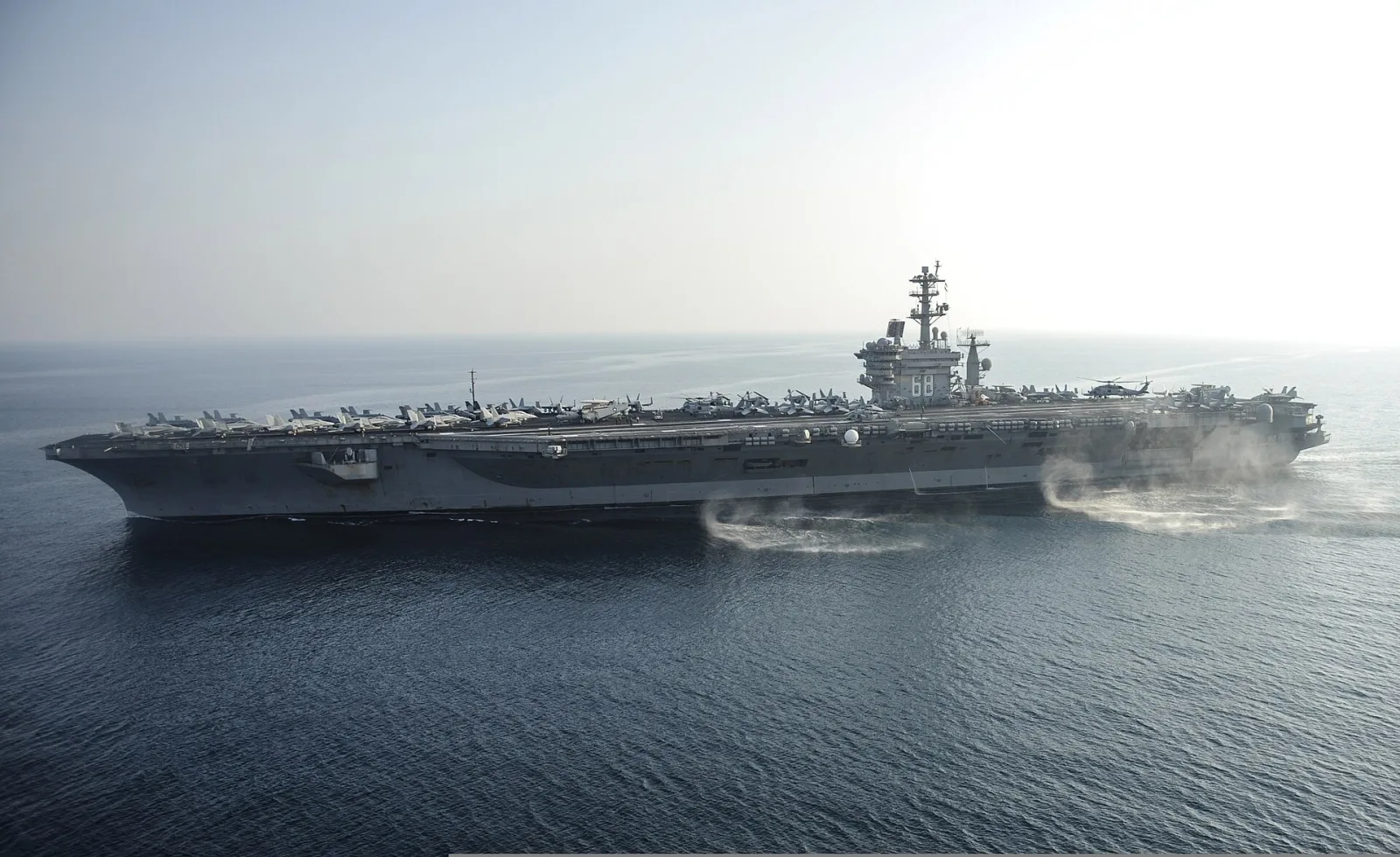
Photograph: The aircraft carrier USS Nimitz (CVN 68) transits the Persian Gulf, US Navy file photo by MC3 George J. Penney III (public domain), via Wikimedia Commons. Graphic by Arab Times UAE.