Iran Defies Trump at UN: Secret Talks and the Seven-Day Hormuz Ultimatum
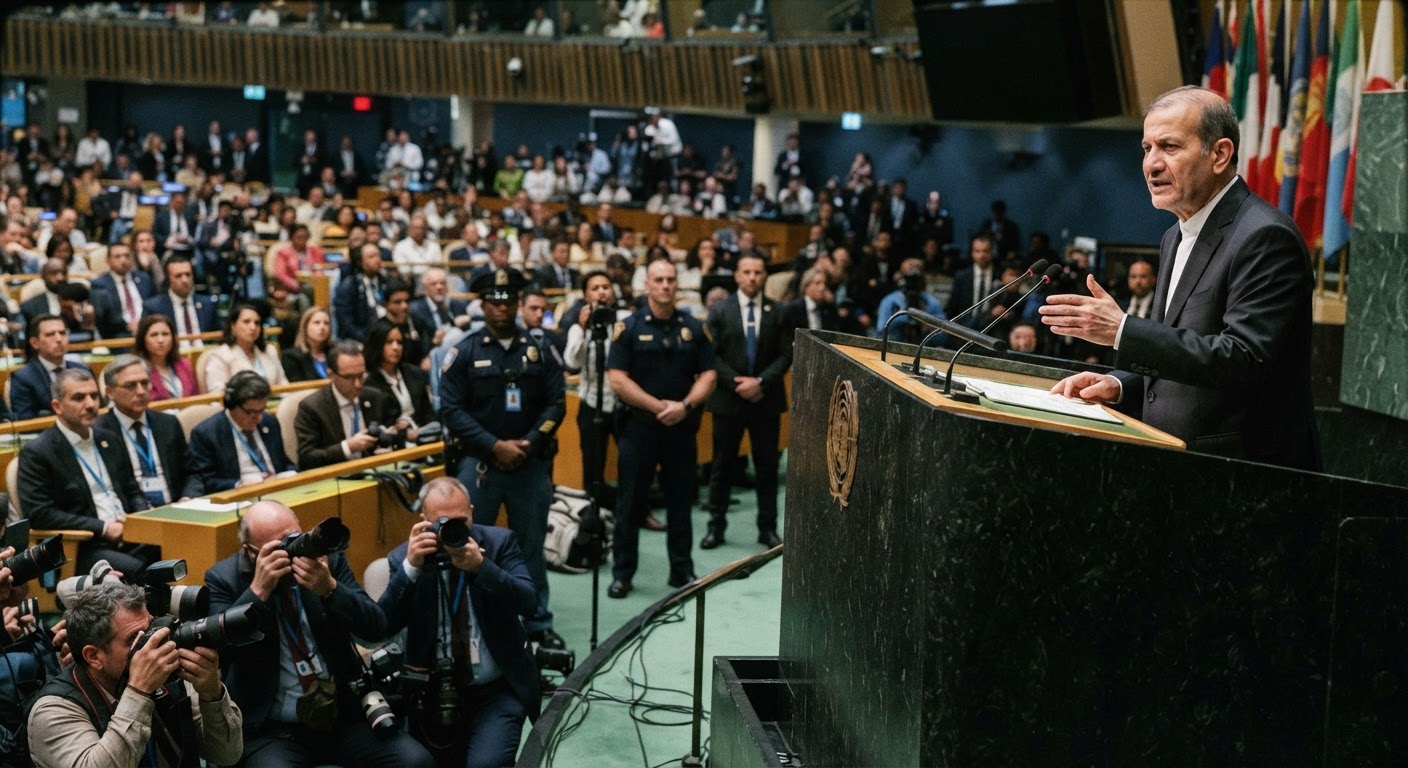
During the 81st United Nations General Assembly in New York on September 23, 2026, Iranian President Masoud Pezeshkian delivered a defiant address that signaled a deepening standoff with the United States. As the U.S. delegation departed the assembly hall, Pezeshkian took the podium to declare that Tehran would not succumb to external pressures, directly responding to threats from U.S. President Donald Trump regarding the future of the Islamic Republic.
A Visual Display of Defiance
In a moment designed to underscore the human cost of recent conflicts, Pezeshkian displayed photographs of the late Ayatollah Ali Khamenei alongside images of children killed in recent hostilities. Addressing the threats of annihilation leveled against his nation, the Iranian leader stated:
"Yes they did hit us, but we did not bend the knee."
High-Stakes Secret Diplomacy
While the public atmosphere at the UN remained confrontational, a significant diplomatic breakthrough may be brewing behind closed doors. On the sidelines of the assembly, a three-hour secret meeting took place, with Qatar serving as the essential mediator. The participants included:
- Iran: Foreign Minister Abbas Araghchi
- United States: Envoys Steve Witkoff and Jared Kushner
While both sides described the discussions as productive, no formal concessions have been made public. However, President Trump has indicated that further discussions could be on the horizon.
Tehran’s Demands and the Hormuz Deadline
The Iranian government has presented a specific set of preconditions that must be met to de-escalate the current crisis. These requirements include:
- An immediate end to hostilities on all fronts.
- The removal of the U.S. naval blockade.
- The unfreezing of Iranian financial assets.
- An end to perceived aggression against the resistance axis.
Pezeshkian issued a significant signal regarding global shipping, noting that the Strait of Hormuz could be reopened within seven days if these terms are met. He also reaffirmed Iran's commitment to defending its civilian nuclear program and maintaining its stance on maritime rights in the strategic waterway.
Regional Security and the Houthi Threat
The ongoing volatility continues to cast a shadow over the Gulf region, posing risks to energy infrastructure and the stability of expat communities in the UAE, Saudi Arabia, Qatar, Bahrain, Kuwait, and Oman.
With the Strait of Hormuz currently restricted, Saudi Arabia has been forced to utilize the Red Sea route for its maritime needs. This alternative path is also under intense pressure from Houthi-aligned forces; reports indicate that Houthi fire reached the outskirts of Riyadh on September 19. As Gulf leaders