Dh3,000. 6 Black Points. 30 Days Impounded. Abu Dhabi's New Way of Catching You.
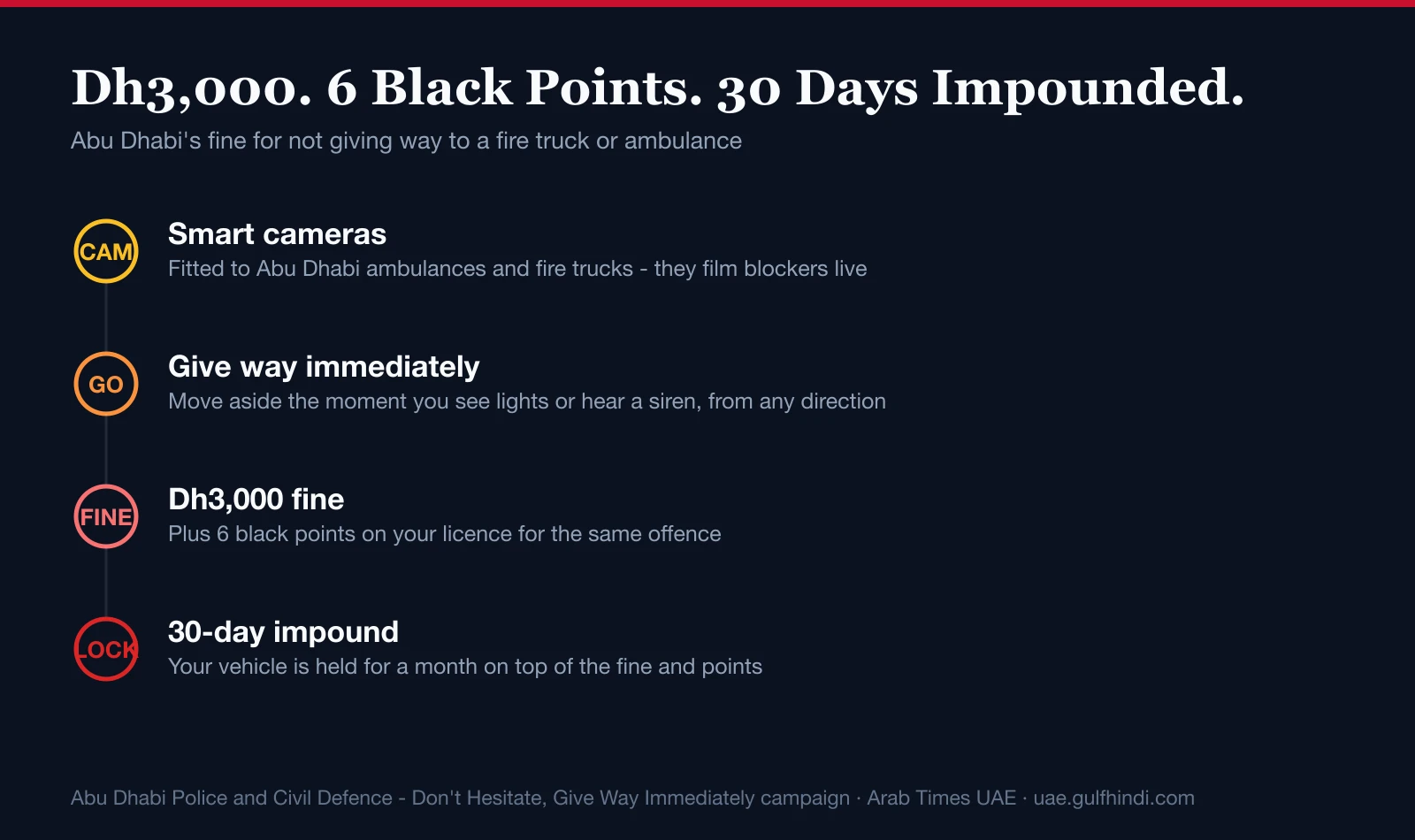
You hear the siren before you see the lights in your mirror. There is a fire truck, or an ambulance, closing fast, and for a second every driver around you does the same thing: nothing, because nobody wants to be the one who moves wrong and gets hit, or moves right and blocks someone else.
In Abu Dhabi, hesitating in that moment now has a price, and the emirate has quietly built the technology to catch every single instance of it.
The fine
Fail to give way to an emergency vehicle in Abu Dhabi and you face:
- Dh3,000 fine
- 6 black points on your licence
- 30 days vehicle impoundment
All three, together, for one offence. That combination — a fine this size stacked with a month-long impound — puts it among the costlier things an ordinary driver can do on an Abu Dhabi road without drinking, racing or causing a collision.

How they are catching it now
This is the part that has changed and the part most drivers don't know about yet. Abu Dhabi Civil Defence has fitted intelligent cameras directly onto its own firefighting, ambulance and rescue vehicles. The system isn't a static speed camera watching a fixed junction — it rides with the emergency vehicle itself, watching the traffic around it in real time.
Two things happen with what it sees. First, it helps the emergency crew: the system is designed to reduce response times by tracking congestion and obstacles ahead and helping controllers pick a faster route. Second, and this is the part that costs drivers money, it records violations and transmits them directly to the operations centre, where they support both deployment planning and enforcement.
In plain terms: the ambulance behind you is filming, and that footage doesn't just sit on a drive somewhere. It reaches the people who issue fines.
The rule you're actually being held to
Give way immediately — the moment you see flashing lights or hear a siren approaching from any direction, not only from directly behind you. Abu Dhabi Police and Civil Defence are running this under a named campaign, "Don't Hesitate… Give Way Immediately", alongside the Department of Health – Abu Dhabi and the Integrated Transport Centre, built specifically around one message: every second an emergency vehicle loses in traffic is a second that can decide whether someone lives.
What "giving way" looks like in practice:
- Check your mirrors continuously in heavy traffic, not just when you happen to hear something.
- Move to the right where you safely can — emergency vehicles are trained to expect this and route around traffic that has cleared right.
- Do not stop dead in the lane. A driver who panics and brakes hard in place can block the ambulance as badly as one who doesn't move at all.
- Do not run a red light to get out of the way faster. Slow, deliberate movement to the side is what's expected — not evasive driving.
- If you're boxed in, edge as far as you safely can and let the vehicle find its way around; the system is built to route around exactly this kind of congestion.
Why Abu Dhabi is pushing this now
However you frame it in traffic-safety statistics, the number that keeps coming up is response time — the minutes between a call coming in and a crew arriving. A driver blocking a lane for even 20 or 30 seconds on a busy road can meaningfully add to that number, and for a cardiac arrest or a structure fire, that margin is the whole difference the campaign exists to protect.
The smart-camera rollout is what turns "give way to emergency vehicles" from a rule everyone nods at into one that's actually enforced at scale — instead of relying on a traffic officer happening to witness the moment, every ambulance and fire truck on the road is now a potential witness.
What to do if you're not sure you complied
If you weren't sure you moved fast enough, or you genuinely had nowhere to go, that context matters and is worth raising if you're fined — but the safest position is simply not to be in that situation. Build the habit now: the instant you register a siren, start looking for your gap, before you've even identified which direction the vehicle is coming from. By the time you can see it, you should already be moving.
The short version
- Dh3,000 fine, 6 black points, 30-day impound — all three, together, for not giving way.
- Smart cameras on ambulances and fire trucks now record and transmit violations in real time — this isn't fixed-camera enforcement, it moves with the emergency vehicle.
- Give way from any direction, the instant you see lights or hear a siren — don't wait to identify exactly where it's coming from.
- Move right and keep moving; don't freeze in the lane and don't run a red light to clear the way.
The message from Abu Dhabi Police is direct: don't hesitate. The fine exists for the driver who does.
This article is journalism, not legal advice. Traffic penalties can change; confirm current rules with Abu Dhabi Police before you drive. Corrections: [email protected].
Graphic by Arab Times UAE.